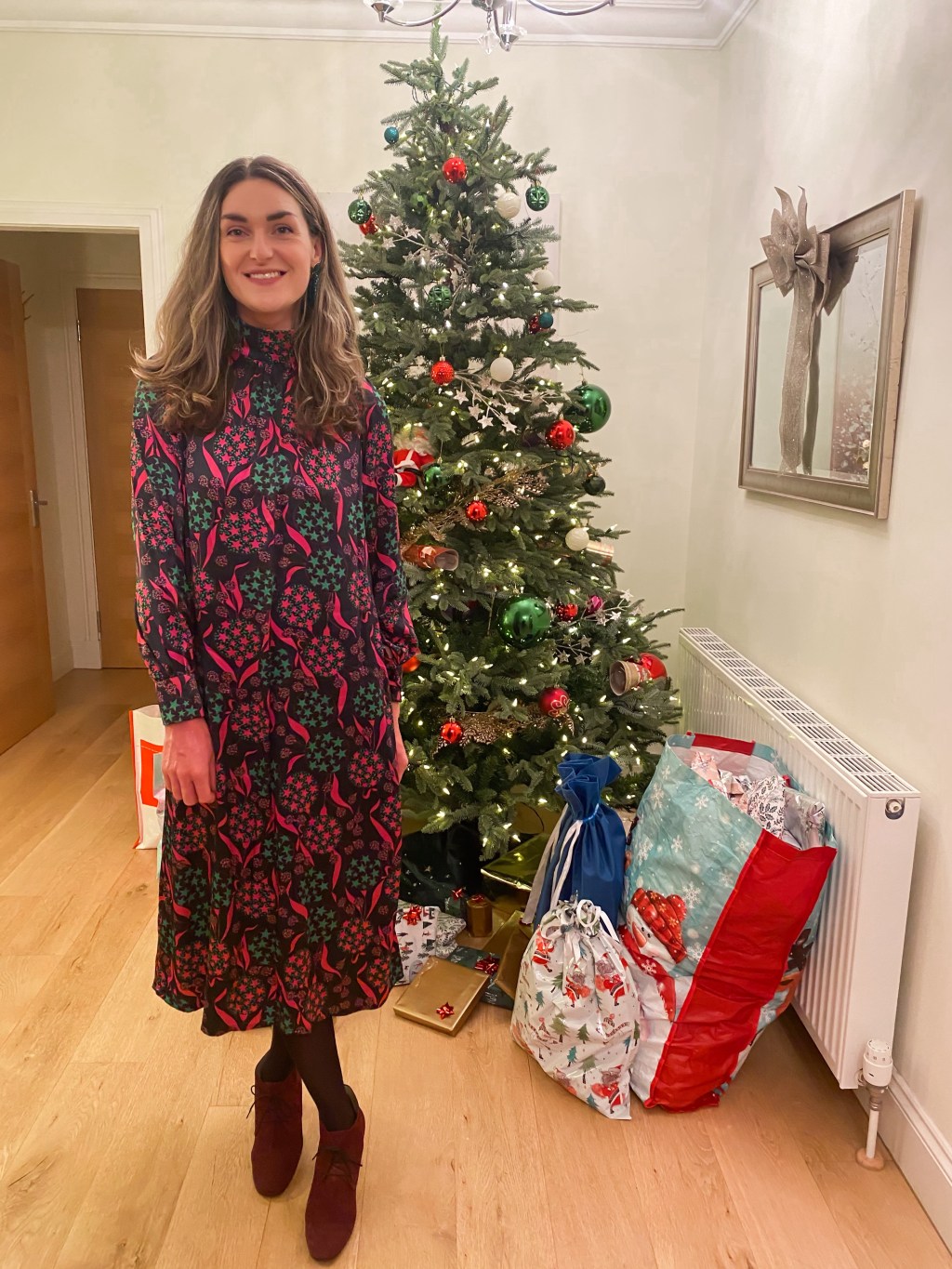
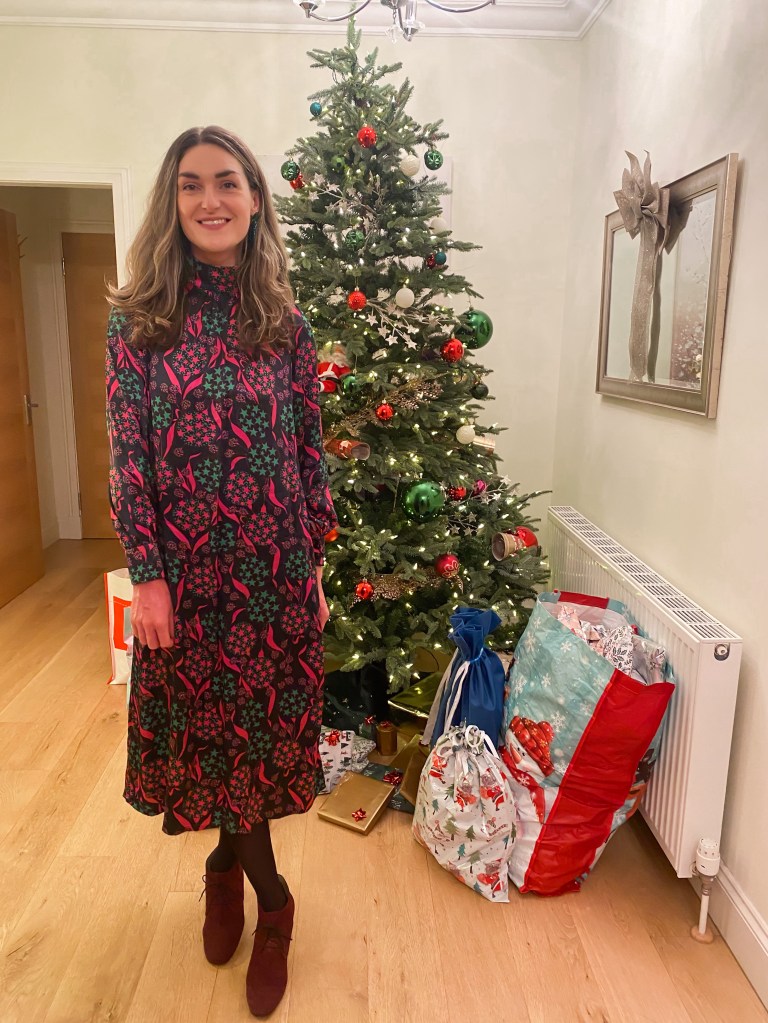
Did you sew yourself a party dress last year? I was thrilled when I opened October’s Dream Wardrobe box from Fabric Godmother to find satin fabric and the Holly dress pattern from Fibre Mood. Despite being a little unsure that this dress style would suit me, I loved the details and thought it would look great teamed with a nice blazer and heels. The Holly dress is a midi dress featuring a standing collar and subtle gathers at the neckline and sleeves; it’s a great piece to sew for the cooler months. It also came together really quickly, so it was perfect to sew in the run-up to the busy festive season.
If you haven’t heard of the Dream Wardrobe subscription by Fabric Godmother, it’s a monthly sewing subscription where you’ll receive a pattern, fabric to make the garment, matching thread, and a sewing-related gift. I signed up last year as I needed a little inspiration for what to sew, and as each box is supported by a blog post, it was a good opportunity to learn some new skills. Owner of Fabric Godmother Julia makes up the chosen garment each month and then shares her notes on the construction process on the Dream Wardrobe blog. I find this helpful and tend to mark up any changes or important points on my pattern instructions so that I can consider these during construction.
Preparing the pattern
Instructions for Fibre Mood patterns can be downloaded via their website. Overall, the steps were pretty straightforward, though I should have taken my advice by reading through all the instructions before starting. I made one major faux pas by not adding the seam allowances to my pattern pieces before cutting. The instructions for cutting the pattern pieces featured at the end of the pattern booklet, so I marked the seam allowance around the fabric before cutting. Luckily, it worked out okay, minus the slightly wonky hem!
Constructing the dress
You can probably tell from the style of this dress that it comes together pretty quickly; the only slightly trickier elements are constructing the collar and cuffs. I followed Julia’s instructions and interfaced each side of the placket and cuffs (as opposed to just one). She also shared a helpful video on ‘how to create a shirt cuff with a continuous lap,’ which explains the process of staystitching the slit at the bottom of the sleeves and then how to apply the continuous lap (or bias sleeve placket). The pattern calls for a 60cm concealed zip. I only had a 20cm zip, but this was fine. I used buttons from Minerva, and again, I only had four in my stash instead of six for the cuffs, which worked out fine.
I prefer the style without the belt, though if you decide to add the belt, Julia recommended cutting the belt 10cm (4 inches) wide; otherwise, it is quite narrow.
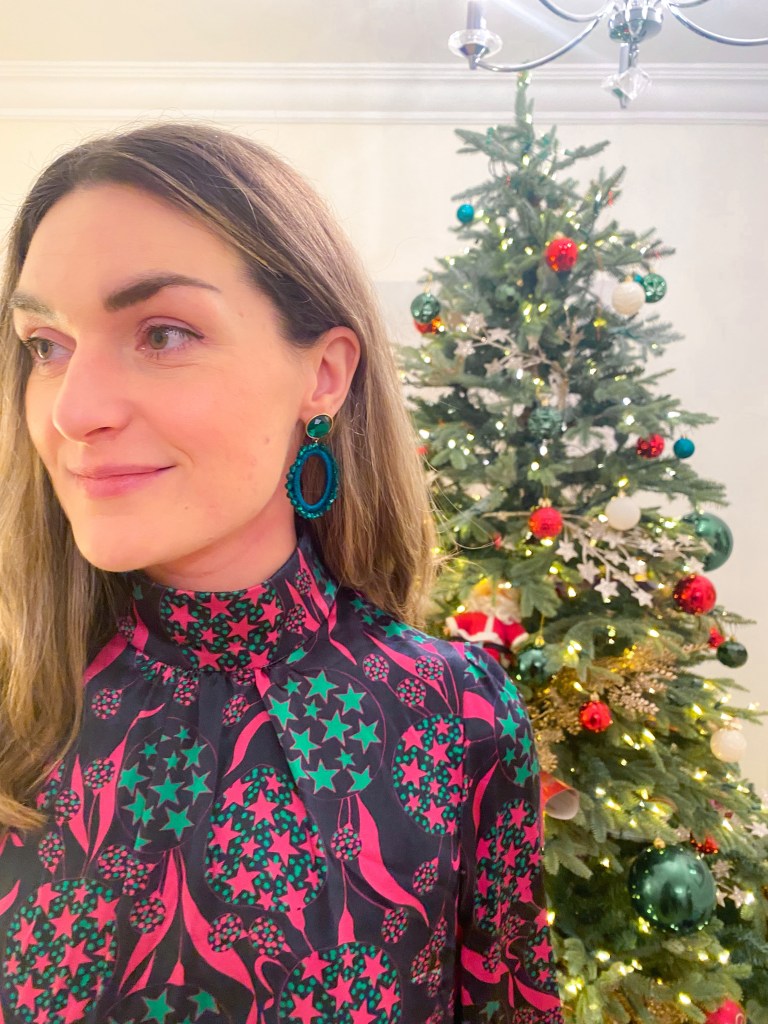
The fabric
The fabric used is 50% viscose and 50% Ecovero, it’s called the Estelle Viscose ECOVERO™ Satin – Midnight. It is a little slippery but presses really well. I’d recommend finishing the seams with a zigzag or overlocker to give it a neat finish.
Next time
If I made this dress again, I would add a few inches to the length; I’m just over 5 feet 7 inches. As I mentioned at the top of the post, this isn’t a style I would typically wear; I think if I were to make a more casual version, I’d add the belt to give a bit of shape; the version without the belt seems to look best on me when paired with heels and a jacket or blazer.
Time to make: This dress could be sewn in a day.
Cost to make: The pattern and fabric were included in the Fabric Godmother Dream Wardrobe box (£59 per month), and I used haberdashery (buttons, interfacing, zip) from my stash.
Key techniques: Sewing a continuous bound sleeve placket and gathers, inserting a concealed zip, adding buttons and buttonholes.
When to wear: This dress could be worn all year round. You can add a belt to the dress and alter the length. Search the hashtag #fibremoodholly on Instagram to see what other sewists have made.
 Lorna Rothery